The North-West Rebellion: The History and Legacy of the Native American Uprising against Canada in the Late 19th Century by Charles River Editors
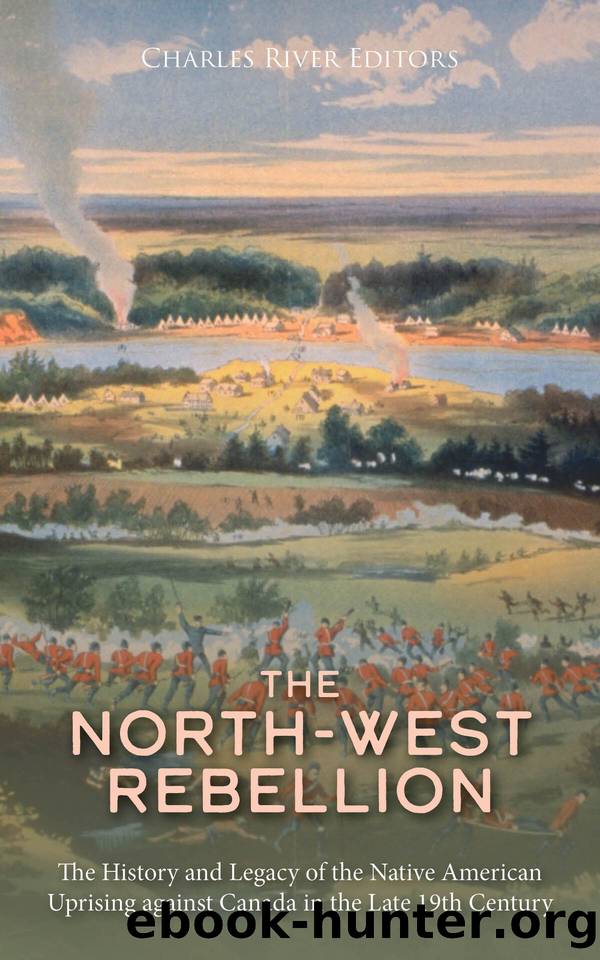
Author:Charles River Editors
Language: eng
Format: epub
Publisher: Charles River Editors
Published: 2023-06-07T00:00:00+00:00
The Dominion of Canada
In 1867, the Dominion of Canada was formed including the eastern areas of the country. Obviously, the new country would benefit from uniting with its western neighboring lands, but the Canadians simply did not have the funds to entice the Hudsonâs Bay Company to sell to the Dominion. Many worried that the United States, who, in the same year had purchased Alaska from the Russians, would seek to purchase Rupertâs Land.[122] Instead, the Company negotiated with the Canadian government, reaching an agreement to sell the company to the dominion of Canada for 300,000 pounds and choice lands. The agreements and subsequent movements of the Indians with the new Canadian dominions meant that the Hudsonâs Bay Company would seek a new consumer for its traded goods. For the first time since its founding, the company would concentrate on selling goods to white men living in Canada rather than to trading with local Indian populations.[123] With the introduction of Hudsonâs department stores and other pursuits, the era of fur dominance was over.
A further consideration of the conditions that forced the sale of Company lands clarifies the changes in both Western Canada and in the outlook for the Company itself. From the time the colonies in North America were established, their growth made western expansion an ever-present reality. The fur trade had played an active role in European western advancement on the North American continent by providing trade routes and a livelihood for those speculating a move west, but with the fur trade came other economic opportunities. The desire of all people groups for manufactured goods caused an increase in traded goods from Europe. Until 1850, throughout Canada and parts of the northern United States, animal pelts were the base currency. Animal skins drove expansion of new markets and trade routes extending to the Pacific.
In the 1860s, tens of thousands of fortune seekers converged upon Canadian territories, specifically British Columbia, looking to strike it rich with gold. This influx of treasure hunters altered trading patterns. People needed shelter and services and with those needs came an increased demand for a variety of goods. The development of roads and infrastructure moved forward to support these new settlers and their search for minerals. Trading furs wasnât as simple as it had been when a few staple items were satisfactory to acquire fur pelts from Indian peoples. To attract this new consumer (many of whom were Americans looking for a new start) arriving in British Columbia, those seeking to trade were forced to decide whether they were going to expand their inventories of goods or lose business to those who were willing to take on the extra cost and risk.
Though expansion was a result of the successful fur trade, it eventually became its demise. As more and more people settled the west, other means of commerce were necessary and the discovery of gold provided that other means. People began to shift from using furs and beaver coins to precious metals, specifically gold. This
Download
This site does not store any files on its server. We only index and link to content provided by other sites. Please contact the content providers to delete copyright contents if any and email us, we'll remove relevant links or contents immediately.
Personalized inhaled bacteriophage therapy for treatment of multidrug-resistant Pseudomonas aeruginosa in cystic fibrosis by unknow(214199)
CONSORT 2025 statement: updated guideline for reporting randomized trials by unknow(102519)
Critical evaluation of the ProfiLER-02 study design and outcomes by Vivek Subbiah & Razelle Kurzrock(102042)
Cardiac gene therapy makes a comeback by Oliver J. Müller & Susanne Hille & Anca Kliesow Remes(101836)
Whisky: Malt Whiskies of Scotland (Collins Little Books) by dominic roskrow(74617)
Unveiling the design rules for tunable emission in graphene quantum dots: A high-throughput TDDFT and machine learning perspective by Şener Özönder & Mustafa Coşkun Özdemir & Caner Ünlü(51000)
A yeast-based oral therapeutic delivers immune checkpoint inhibitors to reduce intestinal tumor burden by unknow(40371)
Covalent hitchhikers guide proteins to the nucleus by Alexander F. Russell & Madeline F. Currie & Champak Chatterjee(40295)
Meet the Authors: Christopher R. Mansfield and Emily R. Derbyshire by Christopher R. Mansfield & Emily R. Derbyshire(40204)
Alkaline-earth metals promote propane dehydrogenation with carbon dioxide through geometric effects: Altering the reaction pathway by unknow(32813)
Induced iron vacancies boosting FeOOH loaded on sustainable Fenton-like collagen fiber membrane for efficient removal of emerging contaminants by unknow(32609)
Efficient electric-field-assisted photochemical conversion of methane to n-propanol exclusively over penetrated TiO2Ti hollow fibers by Guanghui Feng(32528)
Bi2SiO5 nanosheets as piezo-photocatalyst for efficient degradation of 2,4-Dichlorophenol by Hangyu Shi & Yifu Li & Lishan Zhang & Guoguan Liu & Qian Zhang & Xuan Ru & Shan Zhong(32465)
A novel NDIPTA organic heterojunction photocatalyst with built-in electric field for efficient hydrogen production by Jiahui Yang & Baojun Ma & Yongfa Zhu(32438)
Enhanced conversion of methane to liquid-phase oxygenates via hollow ferrite nanotube@horseradish peroxidase based photoenzymatic catalysis by Jun Duan & Shiying Fan & Xinyong Li & Shaomin Liu(32404)
Ordered macroporous superstructure of defective carbon adorned with tiny cobalt sulfide for selective electrocatalytic hydrogenation of cinnamaldehyde by Xiao-Shi Yuan & Sheng-Hua Zhou & San-Mei Wang & Wenbo Wei & Xiaofang Li & Xin-Tao Wu & Qi-Long Zhu(32332)
What's Done in Darkness by Kayla Perrin(27246)
Topological analysis of non-conjugated ethylene oxide cored dendrimers decorated with tetraphenylethylene: Insights from degree-based descriptors using the polynomial approach by A Theertha Nair & D Antony Xavier & Annmaria Baby & S Akhila(26628)
Investigation of mechanical and self-healing properties of hydroxyl-terminated polybutadiene functionalized with 2-ureido-4-pyrimidinone by Mohsen Kazazi & Mehran Hayaty & Ali Mousaviazar(26554)
